Designing a Rainforest
By Mike McLaughlin, former Rainforest Manager
The rainforest at Fairchild Tropical Botanic Garden was not a planned feature, but one that began to evolve in 1959. Over the years, plants had been added to palm plots until the area became the dark, lush forest that enchanted me during my first visit. Tragically, in 1992, 33 years' of growth - dense canopy and intriguing understory - were stripped away by Hurricane Andrew. In the following weeks, the surviving plants were baked by intense sunlight. Unfortunately, restoration of the rainforest had to wait as immediate concerns took priority. Plants that survived the storm did recover, and over the next six years, slowly spread their canopies.
A dramatic turning point for the exhibit came in early 1997. On behalf of the Richard H. Simons Charitable Trust, Robert M. Kramer pledged a million dollars for Fairchild's rainforest programs, giving us the resources needed to rebuild our rainforest exhibit.
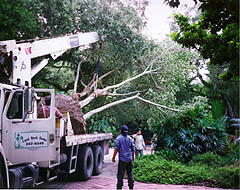 |
| Ficus tree being moved in to the rainforest |
This left us with big questions: How does one rebuild a rainforest? What should our goal for this exhibit be? What sort of rainforest should we imitate? A task force was assembled to answer these questions. After many brainstorming sessions, some guidelines were agreed upon. The exhibit's main role should be to educate. It should emphasize American tropical rainforests, the Caribbean basin in particular, but old world species with important stories about tropical rainforests will be included as well. If all goes according to plan, visitors to the new exhibit will be awed by the beauty that typifies a tropical rainforest, with its luxuriant, sometimes bizarre, plant growth, and its primeval vitality. As they learn from the exhibits guides and signs, their visit will begin to take on real meaning, and they will gain a new appreciation for the importance of these magnificent forests. With the largest outdoor tropical rainforest exhibit in the continental U.S., Fairchild Tropical Botanic Garden will be in a position to bring the lessons of the rainforest to thousands who may never have an opportunity to visit this sort of ecosystem in nature.
One of the most notable new features is a 450-foot stream gurgling through the exhibit. Water pumped from Glade Lake meanders down the 14-foot slope on which the exhibit is located. Adding a stream to the exhibit made the area more beautiful, it also raises humidity levels and provides an opportunity to demonstrate the important hydrologic cycles of a rainforest.
 |
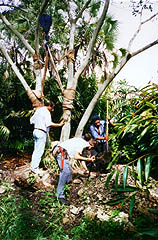 |
| Crane lowers tree in to place | |
The main path winding through the exhibit are made of colored, textured concrete, and are wide enough to permit wheelchair accessibility. To help visitors learn about the rainforest, there are signs, demonstrations, and self-guided tours, allowing each to tailor their tour to their individual interests.
Encircling much of the exhibit is a dense screen planting which keeps drying winds out of the exhibit and act as a visual barrier, enhancing the visitors' impression that they are in the middle of a rainforest. Plantings represent those found in a typical tropical forest, with a high diversity of species and a seemingly random mixture of plant types. To make learning more meaningful, however, there are an increased concentration of particular plant groups. Several theme areas have been developed, one focusing on lianas (woody vines) and epiphytes, both characteristic elements of a rainforest canopy; and others centering on habitat types, such as a light gap, a bog area, and a mature forest. Still other areas will have soil of a different composition from that in the rest of the exhibit.
This exhibit is designed to give our visitors the impression they have just stepped into a pristine tropical rainforest, and teach them why these forests are important.
Garden News
January 1999
Copyright © 2005 Fairchild Tropical Botanic Garden, 10901 Old Cutler Road,
Coral Gables, FL 33156 USA Phone: (305) 667-1651 Fax: (305) 661-8953